Search This Blog

Tuesday, 6 August 2013

On the edge of the world


On a clear day you can see St Kilda from the Isle of Harris. It’s only 40 miles away. In 1838 the island had been inaccessible from the mainland for two years, cut off by the raging storms and ferocious seas yet during that time Charles Darwin had sailed to Australia and Great Britain, not to mention the British Empire, had a new monarch, Queen Victoria, yet the congregation of the church on St Kilda were still praying for “his majesty” until they found out the sex of the new Monarch  - nearly a year after she had ascended the throne. When a steamship arrived carrying tourists in the summer of 1838 the St Kildans were amazed as they have never seen steamships, a mode of transport that was already making transatlantic crossings.

First appearing on a Dutch map in 1666 (to put into context in 1666 Job Charnock was well on his way to claiming Calcutta as part of the British empire) St Kilda has been occupied for at least 4000 years coming to an end in 1930 with the last evacuation of the islanders to the mainland – the current presence of the army and national trust wardens and volunteers in the summer months not withstanding.
St Kilda - Location
The Islands and Stacs that make up St Kilda
It has taken me quite a long time to write this blog but I guess that’s what happens when you try to take in such a mass of experiences and information and try to process it. Which is amazing considering we are talking about what is basically an archipelago of uninhabited rocks in the Atlantic Ocean. What is even more amazing is that this group of uninhabited rocks is one of only 29 places in the world holding UNESCO world heritage site mixed status (both cultural and natural)
Ours was the little boat.....
It was a fairly early start to our adventure but it was much to my surprise and apprehension that we were going at all as the weather had been pretty grim that week and almost as soon as we headed out into the sound it was obvious that it was going to be one heck of a bumpy journey. This trip had all been my idea, a long standing ambition of mine, and about half way into the 2 and a half hour crossing I was seriously concerned that the group were going to want to kill me for yet another one of my “good ideas”. Hamish, not a great sailor at the best of times was the most seriously affected, in fact I have never actually seen somebody turn physically green before and even after disembarking it took him some time to recover. Everyone else was looking to be in various stages of unhappiness except Bert and Simon who seldom seem to be affected by seasickness. For my part fear was probably the overwhelming feeling and I spent a lot of time hanging on for grim death as the aptly named Enchanted Isle climbed up yet another huge wave and crashed rollercoaster style down the other side. No wonder these islands were, and still are, cut off for much of the year by the storms (although nowadays there is a helipad should a real emergency require a helicopter rescue)
Hanging on!
Getting a bit wet...

Not feeling too good...

Feeling great!!!

nearly there

Thats why they let me tag along....to carry the bags...
Everyone was mightily relived once the boat was moored in the tranquil waters of village bay and we were transferred in a little dingy to the pier to a welcome from the national trust warden who was kind enough to look after Hamish. Another boat had made the journey bringing both day trippers like ourselves and volunteers who were staying on the island to help in research projects – one of which was Keith Burns of Carnethy running club. It’s a small world…

The shelter of Village Bay

Off to explore
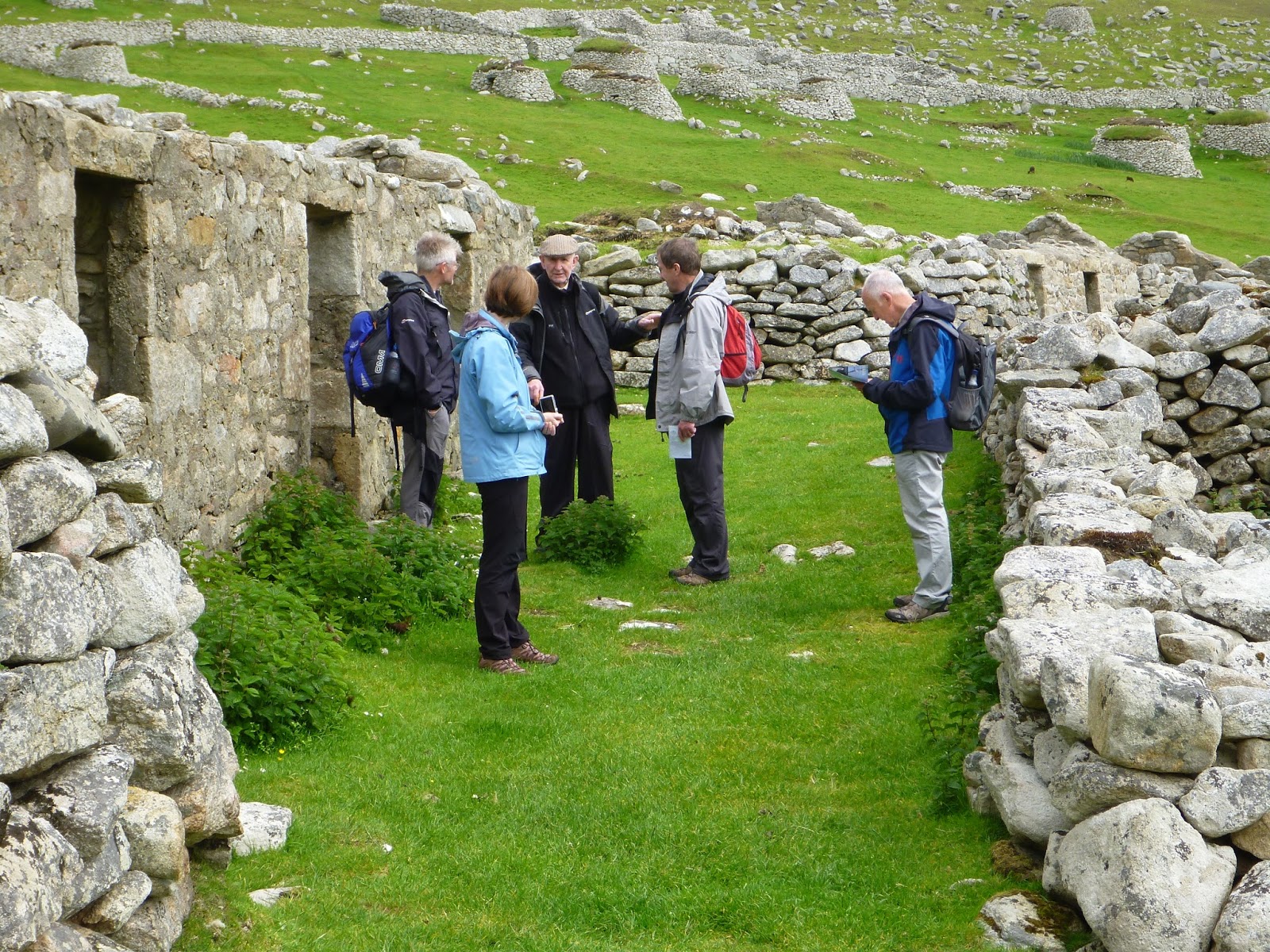
On arrival on Hirta the first thing everyone wanted to do was to head to the main village and see for themselves the setting of the famous St Kilda “parliament “ photo…and of course to re-enact it.
St Kilda parliament (c Tom Steel "The Life and Death of St Kilda)
St Kilda parliament - minus the beards
One of the houses had been turned into an interesting little museum and a few had been restored for various other uses but, similarly to my experiences of the restored Maoi of Easter Island, the unrestored structures still created the greatest atmosphere of loss and of time passing. In some of the cottages the names of the last occupants had been written in white paint on a slate and there was one cottage in particular that one of the group wanted to see. John Angus had been at school with members of one family who had been on the last boat carrying evacuees from St Kilda in 1930 and was keen to see where they had come from.
The village
Exploring
Where my friends used to live!!

Very atmospheric
So why were the islands evacuated? after all people had been living on St Kilda and had been self sufficient for thousands of years? One key factor seems to have been the outside influence of the tourist boats arriving in the latter half of the 19thC bringing with them stories of a different world, an easier life and more importantly teaching the St Kildans about the mighty £. Until then the St Kildans were a completely egalitarian, classless society – share and share alike. They looked after their young, old and the dependents all of whom were entitled to their share of the food even if they had no  role in obtaining it. The work that was to be carried out each day was decided each morning during what has been known as the “parliament”. This was just a morning meeting where the days’ priorities and tasks were set out. Soon though, the St Kildans were selling their weaving and knitted products to tourist boats as well as St Kilda post cards with their very own St Kilda stamps. The more the St Kildans found they could “trade”, that they could sell their wares to passing tourists boats and then use the money that this bought in to purchase food and other necessities then productivity on St Kilda decreased until the way of life became unsustainable, particularly as the young tended to leave the islands if they could leaving behind a shrinking aging population and therefore less people who could carry out the arduous work of scraping a living. The population of St Kilda were eventually convinced to leave for a “better life” on the mainland in mainstream society, the government officals acting as though making the St Kildans conform was for their own good. The last ship containing the evacuees departed from St Kilda in August 1930.
A history lesson
The view from the cliff
Another eroding factor was the influence of the church. Given its location only the most devoted – or fanatical - missionaries would be tempted to go there, particularly those who could have complete control over the lives of the congregation with little outside interference. One notorious minister was the Reverend John MacKay who was resident on St Kilda during the latter part of the 19thC. He took his opportunity to instill his own version of Christianity on the people of the islands which involved banning music and dance and implementing thrice daily church services…people spent so much time in church they did not have the time to give to the real necessary work of trying to stay alive through their subsistence farming. Many people make the dubious argument that the church is good as it has a cohesive effect on a community but in St Kilda the only effect was to have some members promoted into the minister’s assistants which separated them from their society in which, until that point, all members were completely equal. In fact MacKay used members of his congregation to spy on other members of the community who may not have been following the word of God…or his interpretation of it.
Exploring the churchyard
With such a remote population the obvious question is regarding relationships and intermarriage but the St Kildans did take steps to ensure that they weren’t known for their banjo playing abilities. In 1876 out of 14 married couples on the island not one couple were even first cousins and at that time it was documented that no member of the population of St Kilda showed any signs of “abnormalities”. Such was the fear of the results of interbreeding the minister kept family trees and had to approve a marriage for it to be allowed and young men often went to the mainland in search of a wife. One of the main concerns of the nurse on the island at the time of the final evacuation was that with the dwindling population some relationships were becoming “too close for comfort”.

What St Kilda and the St Kildans are most famous for are the part the colonies of seabirds have played in feeding the population of St Kilda for hundreds of years. The “bird people” of St Kilda undertook the perilous sea crossings and ascents of the cliffs of the islands and sea stacs to harvest the sea birds, mainly “guga” or young gannet, fulmar and puffin and this comprised the main stay of the St Kilda diet. The climbing was all done in bare feet with very basic ropes for safety. Keep in mind that a grown fulmar has a wingspan of over 5 feet and a very large beak and its not wise to annoy one so often the slaughter was carried out at night under the cover of dark. Boys were taught to climb in childhood and even the feet of the people of St Kilda evolved to be different from people on the mainland with developments that assisted them in climbing such as a different bone structure in the ankles and spacing between the toes. The men would go by boat to the neighbouring islands or stacs and spend several weeks there harvesting the birds which would be bought back to the village and divided up equally amongst the residents.  Salt was a rare commodity and so and the birds would be dried out to preserve them for winter. On one such expedition the men found themselves staying at their hunting site – perched on the side of a sheer rock stac- for a lot longer than planned. The boat that had dropped them off never returned when the men lit the fire that was the signal that the hunt was complete and they were ready to return to the village with their haul of seabirds. This is because while they were away smallpox had decimated their village of menfolk leaving only women and children who were unable to man the boats to go rescue them. They were left on the stac for some months before their eventual rescue.
A potential dinner..?
Exploring the cliffs

The white colouring of the cliffs is the seabirds nesting on the cliffs

The landscape of Hirta is dotted with more than 1400 little stone constructed turf roofed huts called “cleits” and the purpose of these cleits was for storage, their construction ensuring that whatever was stored inside could be kept dry by the drying effect of the wind blowing through it – including stored sea bird carcasses. The ability to survive through the winter was down to what could be caught or grown, or procured from passing ships, and what could be preserved as the islands were often cut off for at least half of the year by the weather. Now the cleits are occupied by nesting birds. As you can imagine the diet of the St Kildans was very limited to the seabirds that they harvested along with the eggs, and oats and potatoes that they managed to grow. They did not eat mutton or beef despite there being sheep and some cattle on the island preferring to stick to their traditional diet….oh no, not puffin for dinner AGAIN!
Cleits dotted all over the hillside
Exploring a cleit
More cleits
and yet more of the 1400 or so cleits found on Hirta, the main island of St Kilda
We walked around the village, the churchyard and the cleits before selecting a vantage point from which to sit and admire the view and have lunch…and break open the fine bottle of malt that I had bought to celebrate this very special trip. My theory is that whisky helps with sea sickness but not everyone was convinced of this. After lunch we climbed up “the gap” to look down on the cliffs and the nesting seabirds and to look at the island of Boreray and Stac Lee some 4 miles away.
A fine bottle of malt to accompany lunch
Taking in the views and the atmosphere
The view from Hirta to Boreray, Stac Lee and Stac an Armin

Relaxing on the clifftop...dont look down!!


The viewpoint from "The Gap"
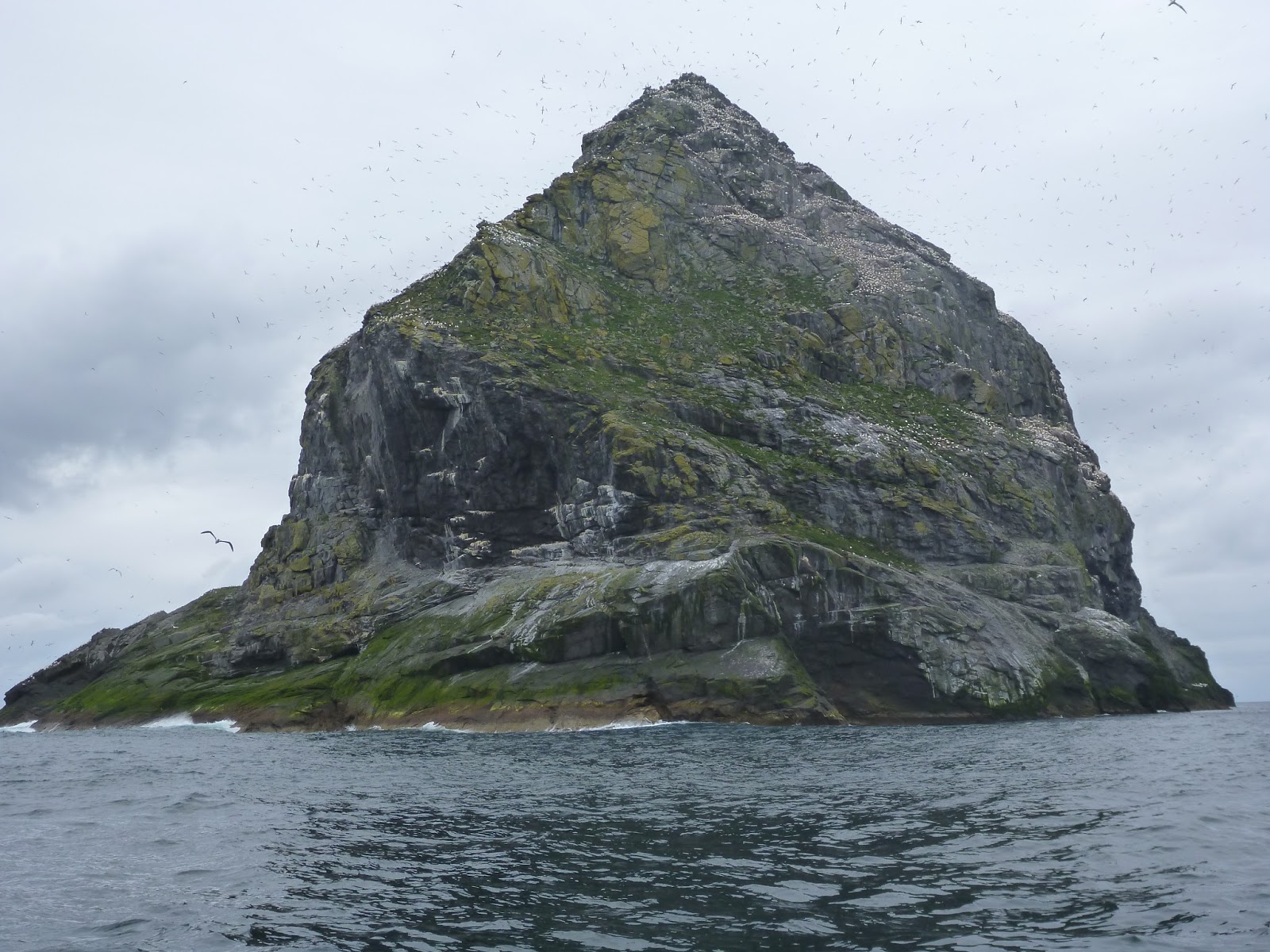
Many thousands of birds and their eggs were taken by the islanders (in 1876 it was estimated that somewhere in the region of 89000 puffins were killed that year – and that’s not including the fulmars or gugas). However the cliffs were always repopulated each year and now the cliffs and stacs of St Kilda form one of the most important sea bird colonies in Europe and the largest fulmar colony in Britain. After the obligatory trip round the tourist shop was complete (yes I did succumb to a St Kilda fleece with a rather nice picture of a puffin on it, as always I am a tourist shop’s dream visitor) and after our precious few hours on Hirta were up we were taken back on board the Enchanted isle for tea and cake and then we were taken for a little journey around the rock stacs to look at the birds. The stacs - Stac an Armin (191 metres) and Stac Lee (165 metres) - are the highest sea stacs in Britain and rise out of the water to tower above the ocean waves crashing below as more birds than you can possibly image populate the cliffs, bob about in the water and swoop past. Bert was the only one of us who has a camera remotely suitable to the task and I think most of our attempts to capture the sheer scale of the scene digitally were futile – and a bit blurry. If you have any bird related phobias then this may not be the trip for you.

Time for tea and contemplation
Competition for the ultimate "National Geographic" photo
An evocative scene
Seabird colonies
Hope he remembered to take off the lense  cap...
We sailed all around the islands, cliffs and Stacs

Sea birds are not the only wildlife that St Kilda is known for and just as the human population of St Kilda evolved their own characteristics to enable them to live in this environment so too did other species. One of the first things you will notice on walking round the village is the number of sheep roaming about. These are Soay sheep, their ancestry dating back to the bronze age and they were used by the St Kildans for their wool. The St Kildans would pay their factor, MacLeod of Macleod of Skye, in rolls of tweed, and the knitted products formed the basis of the St Kildan’s trade with tourists. The St Kildan sheep are found on both Hirta and Boreray and as you would expect are very agile. They also seem to have distinctive yellow eyes making them look quite prehistoric (and a bit evil but maybe that’s just my imagination). St Kilda also had its own species of house mouse which was bigger than the type found on the mainland but which died out when the houses on St Kilda fell into ruin and there is also the St Kildan wren which again is larger than the wren found on the mainland and it is estimated that there about 115 breeding pairs on the islands.
Gannet in flight
Gannets nesting on the cliffs
During the First World War a submarine appeared in village bay and fired at the island to try to destroy the radio station that had been installed there by the navy a couple of years earlier. That must have been some experience for the people of the village – a real awakening and introduction to the 20th Century!  After the outbreak of WW1 the island, ideally located for monitoring shipping in the Atlantic, became a war signal station for the duration of the war. Not used during WW2, apart from by a couple of planes which managed to crash into them, the islands have had an army presence since 1957 related to a missile range on Benbecula. A whole new settlement sprang up next to the now deserted village in the form of army barracks and the wonderfully named “Puff Inn” pub/canteen (not open to the public – damn) hmmm…wonder if puffin is on the menu as a bar snack…?

A relic from the First World War

The 20thC military buildings make an interesting contrast with the traditional stone cottages and cleits
St Kilda is now owned by the national trust and so the only other occupants of St Kilda are the national trust wardens and the work parties that they organise in the summer months to maintain and repair the buildings in the village or to carry out scientific studies of the plants and animals, the Soay sheep population is undergoing a study at the moment for example. I have to say the opportunity to come back to these magical islands maybe as part of a work party is tempting, I would love to stay a few more days. The four or five hours that we spent on the island were not nearly enough and there is so much more to do, see and explore.
Cleit restored by a National Trust work party

A restored cottage

Grazing Soay sheep
The journey back was a lot gentler and we were all glad of this so it was a happy, tired group that disembarked at Leverburgh that evening.
Sailing back to Harris Bert took on a scary resemblance to the mad captain in the Jaws film
But the excitement was all just a bit too much for some people
 
Celebratory dinner
Would I go again? Like a shot! It’s so remote, visits are entirely weather and sea dependent and it’s not an easy or comfortable journey to get there – make sure you bring a decent waterproof jacket and shoes. St Kilda is a magical place that has a lasting effect on everyone who visits, a feeling of visiting somewhere very special and being amongst the few who have been privileged enough to do so.  I suspect more British tourists have visited other UNESCO world heritage sites such as the Taj Mahal than have visited St Kilda - after all, from London you can probably get to Delhi quicker than you can get to St Kilda and at least the inflight hosts on a BA flight give you gin and tonics and a pillow rather than just carry out the buckets of vomit from the cabin….rough crossings are the norm rather than the exception. Next time I go I would like to try to kayak between the islands and round the Stacs, although possibly not actually kayak to St Kilda itself!. I think that will be the ultimate way to experience these islands but i also suspect it will be a real challenge.

Hamish felt a lot better on the return leg of the journey - he even smiled!
The weather was kind to us that day and in fact we had the only day that week where sailings to St Kilda were possible. These difficulties make visiting these islands an even more tantalising prospect.


* All facts and figures quoted here come from the following sources
Seamus Morrison -  http://www.seaharris.co.uk/boat/
The information available in the museum on the Island supplied by the National Trust and the website http://www.kilda.org.uk/
and finally Tom Steel's book "The Life and Death of St Kilda", A "must read" for anyone planning on going.
Suffice to say any inaccuracies in the above blog posting are mine and mine alone.


Thursday, 25 July 2013

Things to do in the Hebrides when it’s raining...


I have often gazed with bemusement at friends’ holiday snaps posted on facebook of bikini clad folk sipping drinks in the Mediterranean sunshine by a pool while the deep blue Mediterranean  sea glimmers in the background. Why do my summer holidays so often seem to involve full water proof body cover, welly boots and frantically sought out places to shelter from the weather?


Things to do – Number 1 - Go cycling!!!

The Golden Road - a great cycle route
But its a bit hilly...
 The Golden Road weaves its way along the east coast of the Isle of Harris passing peatland, lochans, rocks, and isolated cottages looking out to the waters of the Minch. It is so called the Golden Road due to the disproportionately high cost of its construction, the terrain and the undulations comprising to make its construction a tricky task. As it is a spectacular route we decided that a little cycle ride would be the best way to appreciate its beautiful setting and its challenging hills and so much the better if there was a tea room involved somewhere on the way. The group reduced in size proportionately according to the length of time it took to find a tea room but eventually we found one and not a moment too soon as the heavens opened as soon as we sat down, it was already pretty windy so the horizontal rain was not really tempting us away from our tea and cakes and we stayed for “seconds”.  Every so often we stuck our noses out of the door to check on the progress of the rain and once the rain flurry had passed overhead we were on our way once more. Clearly the break in the rain had lulled us into a false sense of security as we hadn’t been pedalling for more than 5 minutes before the rain was once again coming in horizontally and so, bored with waiting and clearly fearing hypothermia, Simon took off. Bert, displaying a cadence that Chris Froome would be proud of, followed in hot pursuit whilst John and I pedalled slowly home completely drenched. No doubt John was cursing yet another ”great idea” of mine. 

Things to do - number 2 – Cookery!!

Feeding time!
The Hebrides. Surrounded by seas, famous for its fishing  and fantastic sea food….now go figure out where to buy fresh fish in Tarbert because we sure as ‘eck couldn’t. Other than being able to get great seafood in the hotels and restaurants there was not much to be bought in the village. Fortunately we had stocked up with scallops during our drive up through the islands and our one optimistic trip into the village to buy fresh fish resulted in a large purchase of….tinned tuna. One of our party was vegetarian and so that pretty much informed our cookery options for the week as Cath and I worked as a little team to keep them all fed and happy with large bowls of stir frys and pasta dishes.  Scallops were the catch of the day and Cath and I we felt we needed some expert advice to prepare them and so another member of the group, who shall remain nameless, was added to the kitchen team intent on producing a starter of black pudding, scallops and poached egg – a sort of Hebridean surf and turf. However he cracked under the pressure of preparing our treasured scallops. Anyone would have thought it was an episode of masterchef he’d been asked to compete in and, in a scene reminiscent of Ramsay’s kitchen nightmares, he shouted and crashed around as Cath and I stared on in total bemusement. Suffice to say Cath and I did the rest of the cooking for the week without any further“assistance”.

Things to do – number 3 - Run a half marathon!!

A glimpse out of the window didn’t do much to lift my spirits on race morning. We slowly packed up and said goodbye to the lovely house that we had been staying in for the past week and its perfect coastal setting and packed up the cars while the rain battered down yet again in true Hebridean style –  ie horizontally. Pre race tea and cakes with Rob, Cath,  John and Bert in the little tea room lifted my spirits a bit and the arrival of trotters en masse lifted my spirits a lot so by the time the buses departed for the start line in the mist and gloom there was a lot of the usual merry banter. Simon hadn’t recovered from the injury he had sustained on the Barrathon and retreated to the pub to watch the rugby just emerging in time to watch the last 3 miles of the race on his bike.

Dean and his trusty steed
Megan
It was a tail wind and so many people were describing the conditions as ideal but I was less than convinced of this as I stood on the start line shivering in my thermal top. When you have a bad race it’s tempting to go on at length about what went wrong. So guess what I’m going to do….. well, ok I will spare you that as I think it can be neatly summed up by saying that for 13.1miles I wished I was elsewhere and only finished because of that bloody Heb 3 t shirt (my 6th consecutive Heb 3 t shirt). Dean cheered me up with his support as he zipped up and down the course on his bike and needless to say Bert was perched at the top of the hill poised with his camera to capture in full glorious technicolour the extent of my cold, slow agony. Git. 

I really wasn't having much fun
 I have never experienced quite the same cramping like symptoms before, first of all my quads seized completely swiftly followed by my back and backs of my legs and the muscle spasms and shooting pains down my legs and lower back continued during any exercise for the next 10 days or so – anyone got any ideas as to what could cause that? 

Cath on her way to a seasons best
Whatever the cause I saw Ellis and Eilidh disappear into the distance closely followed by John. I tried to stay with Hamish (my Heb half nemesis) for as long as possible but he too scampered away and by the time I had reached the point of complete sense of humour failure Carrie and Anna had left me to trail in slowly to the finish. 
My Heb Half Nemesis
He's having way too much fun!!
I often think it’s a shame when I do this race and barely notice the stunning scenery as we race alongside one of the most beautiful beaches in the world but a glimpse at Bert and Simons photos confirmed that the bleak Hebridean landscape had indeed been shrouded in a damp claggy mist for the duration of the race and we were not to witness the usual sparkle of the golden sands and azure blue sea of Luskentyre as has characterised the Harris half marathon in previous years and I did feel it was a shame for the “first timers” to the island. But hey, that’s the Hebrides for you but when the sun shines on the Hebrides there is nowhere better. 

My prize!
and the sunshine appears...

does it smell ok..??

Perfect recovery food
 By the prize giving I was feeling better and glad that I had hung on enough to win the prize for the first old lady in the Heb 3. Trotters had won first team in the Heb 3 and the usual suspects, Gillian and Megan picked up prizes and there was even a prize for a little Mowbray in the fun run. By the time we all descended on the pub I was much happier and the change in my spirits was matched by the change in the weather and it turned into a glorious afternoon followed by a glorious sunset witnessed from the decks of the Calmac “booze cruise”.
Enjoying the sea air
Yet another glorious Hebridean sunset
Bye for another year!


Things to do – number 4 – Archaeology!!

All across the Hebrides the echo of times long past can be witnessed in the land, the architecture, folklore, traditions and archaeology. Maybe it’s because of the hostile environment as people now, as they have for two millennia, make a living from the land, cutting the peat since time immemorial and providing a living link with the past. 
Carloway Broch
The fascinating archaeological remains include a norsk mill and chambered cairns that I have visited on previous trips to the Hebrides. This time I was acting as tour guide and so I thought that my little gang of tourists would all appreciate the magnificent Broch of Dun Carloway which dates from 1st century BC (Iron age, I think) and apparently was last occupied in 1300AD. An imposing fortress designed to protect against both invaders and the weather, it stands some 9m tall and in places its walls are 3m thick. We huddled in the shelter of the walls making use of its well designed  protection against the wind and rain.

Staircase within the outer wall
Many theories have been put forward for the construction of standing stones especially to do with the timing of solar and lunar astronomical events, equinoxes ect but I don’t think anyone really knows for sure why these monoliths were erected. What is certain however is that they are beautiful landmarks and the Callanish stones are no exception and create of a landscape full of mystery.  The guide book states that “Evocative times to visit include dawn and dusk, when the moon is full or when this mist rolls in from the sea” and I’ve even seen equally evocative photos of the stones during rare snowy winter days.
Callanish Stones

An ancient mystery
The guide book makes no mention of visiting the stones in horizontal rain and gale force winds. Still, it was atmospheric. In fact wildly so, an ancient structure built by ancient peoples for reasons long lost in the mists of time in a wild untamed environment viewed in  inhospitable hebridean  weather – what more atmosphere could you want?
Some ancient ruins...and the Callanish Stones
Considering the weather it was just as well there is a nice tea room at the visitor centre along with an interesting shop selling all manner of interesting touristy stuff so we took shelter from the wind and rain in there. All except Bert. Bert had spotted a pig in a field, a rather magnificent specimen it has to be said, and he was determined to photograph it no matter that the rain was lashing down. However even the pig had, unlike Bert, the good sense to run for cover from the rain so no photo for Bert.

Black house village
 Our final stop on our history tour was the Blackhouse village of Gerrannan, a cluster of traditional Hebridean blackhouses by the sea now turned into a working museum, self catering accommodation, a youth hostel and the ubiquitous tea room and gift shop. The weaving on Harris on a traditional loom had us all fascinated but the man was not forthcoming with an answer to Bert’s question “ why isn’t it Lewis tweed if it is weaved on Lewis” and he looked at us all as if we were stupid. Can’t think why…
Weaving Harris Tweed
The Blackhouse museum was kitted out as it would have been when it was inhabited and was very interesting, transporting you back in time, and was surprisingly cosy.  I am very tempted to book a Blackhouse cottage for a week sometime. Anyone want to join me…? 
The village was last occupied in 1974
 A Blackhouse is a traditional type of single storey, thick dry stone Hebridean house with a thatched roof. There was a central fire but no chimney for smoke to escape from and the smoke just went up through the roof. The people occupied one side of the house and lived cheek by jowl with their livestock in the same house with a partition between the living quarters of the people and the area where the animals were kept. This type of house was ideally suited as protection against the fierce Hebridean weather and Gearrannan was occupied until the 1970s. 

I really want to stay in one of these!!
Amazingly we gave the tea room a miss and opted to go to Stornoway in search of one in which to end our tour.

Blog Archive